Sand Acknowledgement

MUSEUM LABEL
DESCRIPTION
The connection between the First People and their ancestral land is important.
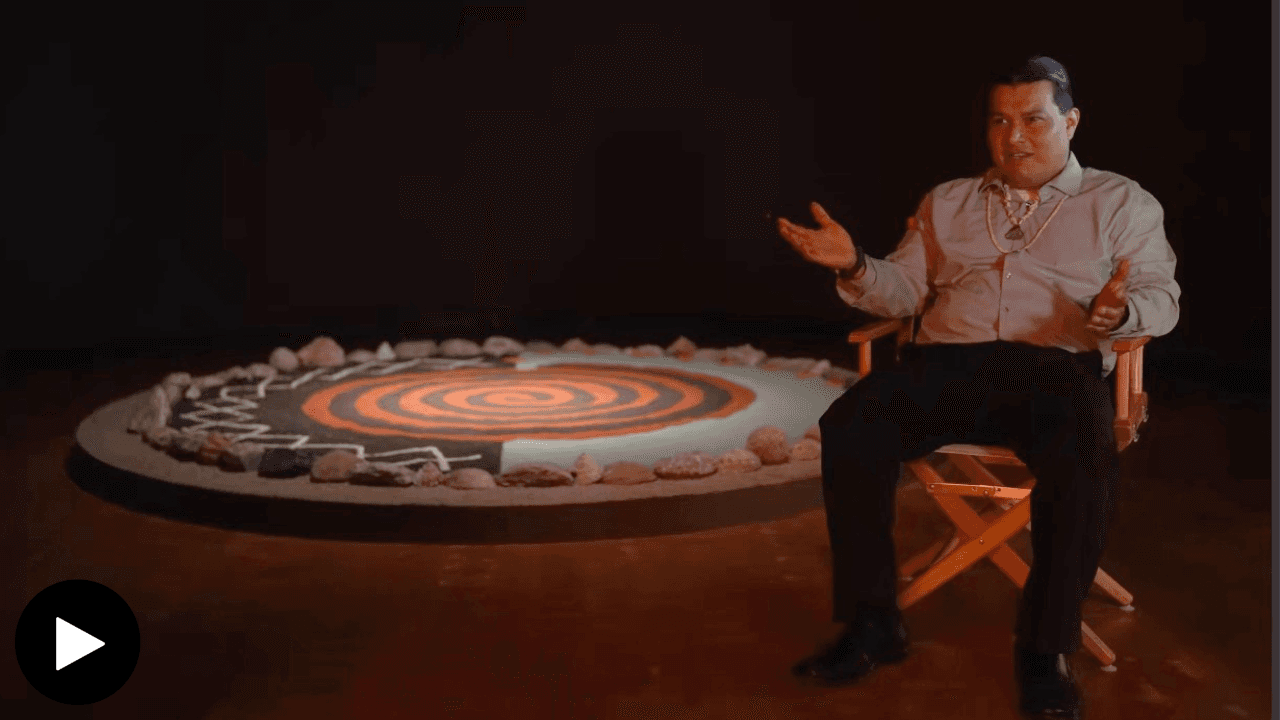
The Gabrieleno culture is shaped by land-human-cosmos relationships. Our ancestors expressed their understanding and respect for nature through sand paintings. Sand Acknowledgement is formed from natural pigments of the Earth and becomes its own being, as well as a reflection of the local Indigenous experience in nature. Sand paintings document changing seasons, constellations, and other celestial bodies; and become a form of literacy for community cohesion and knowledge transmission. This ephemeral medium returns to the earth at the end of its time and remains in the memory of those who are present to see it.
There is a natural literacy involved in creating and looking at this being. Sand Acknowledgement outlines one of the most important relatives of the natural world—Taamet (Sun)—embodied by a hanging abalone disk and echoed on the ground by a red spiral. Taamet’s role in this dual relationship with the cosmos is to shed heat and light upon the Earth. Taamet dances around the other sky people (Birds, Moon, Stars) as a representative of the fire element necessary for life. The understanding and relationship between the Taraxaatam (people) and Taamet were stronger in ancestral times and has since faded for most people. Colonial practices and modern conveniences limit the need to respect and abide by the seasons for food, shelter, clothing, etc.
Sand Acknowledgement is my response to performative land acknowledgements without notable outcomes. It illustrates how this revitalized tradition rooted in natural literacy activates a useful practice that supports relationships, respect, reverence, and acceptance. Together, these form the cultural etiquette that can connect us to a better understanding of ourselves and our place in this world and beyond.



39
VIDEOS






4
PEOPLE

Char
Miller
W.M. Keck Professor of Environmental Analysis and History
Pomona College in Claremont, California


THEMES
ADDITIONAL RESOURCES